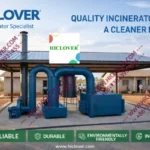
High-Temperature Incineration Solutions for Hazardous Waste Treatment and Recycling Bases
As global regulations on hazardous waste (HW) management become stricter, hazardous waste treatment centers and recycling resource bases are under growing pressure to adopt disposal technologies that are safe, compliant, and scalable. In regions such as Southeast Asia, West Africa, Eastern Europe, and the Middle East, centralized hazardous waste facilities and plastic recycling parks are expanding rapidly to handle increasing volumes of mixed industrial waste.
In these environments, industrial high-temperature incinerators play a critical role in treating non-recyclable, contaminated, or high-risk waste streams that cannot be safely landfilled or mechanically recycled.
Typical Application Scenarios
Hazardous waste incineration systems are commonly required in:
-
Centralized hazardous waste treatment centers serving multiple industrial parks
-
Recycled plastic factories handling contaminated or solvent-laden materials
-
Chemical and pharmaceutical waste hubs located near ports or free-trade zones
-
Regional waste transfer stations supporting mining, oil & gas, and manufacturing clusters
These facilities are frequently found in industrial corridors in Indonesia and Vietnam, coastal recycling zones in Turkey, chemical parks in Egypt, and emerging hazardous-waste bases in Nigeria and Kenya, where mixed waste streams and limited downstream treatment options coexist.
Waste Streams Requiring High-Temperature Incineration
Unlike ordinary municipal waste, hazardous waste and recycling residues often contain unstable or toxic components, including:
-
Mixed plastics contaminated with oils, inks, or additives
-
Solvent-containing residues from plastic washing or chemical cleaning processes
-
Chemical packaging such as drums, liners, and composite containers
-
Residues with halogens or heavy organic compounds
These waste types pose risks of secondary pollution if handled improperly. Controlled high-temperature thermal destruction remains one of the most reliable disposal methods.
Industrial High-Temperature Incinerator Configuration
For hazardous waste and recycling bases, a three-chamber industrial incinerator design is typically recommended:
-
Primary combustion chamber
Designed for stable feeding of mixed plastics and packaged waste, maintaining consistent high temperatures for complete destruction. -
Secondary combustion (afterburner) chamber
Ensures full oxidation of volatile organic compounds (VOCs), solvents, and unburned gases, significantly reducing toxic emissions. -
Tertiary retention or mixing chamber
Extends residence time and stabilizes flue gas before treatment, especially important for solvent-rich waste streams.
To further control emissions, activated carbon adsorption systems are integrated to capture dioxins, furans, and residual organic pollutants before discharge.
More technical details on industrial incinerator configurations can be found at
https://www.hiclover.com/industrial-waste-incinerator/
Environmental Control and Compliance Considerations
Hazardous waste treatment facilities are often subject to EU-style emission limits, even outside Europe, particularly when projects are linked to international financing or ESG requirements. A properly designed system typically includes:
-
High-temperature combustion exceeding regulatory thresholds
-
Multi-chamber thermal control to prevent incomplete burning
-
Activated carbon injection or adsorption modules
-
Optional wet or dry scrubbing systems depending on local regulations
These design principles are aligned with international best practices for hazardous waste incineration, particularly in recycling zones handling solvent residues.
Modular and Site-Adaptable Design for Recycling Bases
Many hazardous waste and recycling parks operate under space, logistics, or permitting constraints. For this reason, modular or containerized incinerator solutions are increasingly favored. They allow:
-
Faster deployment within industrial parks
-
Easier integration with existing recycling lines
-
Reduced on-site construction and civil works
-
Flexibility for future relocation or capacity upgrades
An overview of containerized and modular incineration systems is available at
https://www.hiclover.com/containerized-incinerator/
Supporting Circular Economy and Risk Control
While recycling remains a cornerstone of the circular economy, not all waste streams can or should be recycled. High-temperature incineration serves as a critical safeguard, ensuring that hazardous residues and contaminated plastics are safely neutralized without transferring environmental risk downstream.
In regions where recycling infrastructure is still developing, incineration systems also provide long-term risk control for governments and private operators managing hazardous waste bases.
General information about integrated hazardous waste solutions can be explored at
https://www.hiclover.com/
Conclusion
For hazardous waste treatment centers and recycling resource bases, especially those handling mixed plastics, solvent residues, and chemical packaging, industrial high-temperature incinerators with three-chamber structures and activated carbon adsorption represent a proven, regulation-aligned solution.
As industrialization and recycling capacity continue to expand across emerging markets, robust incineration systems will remain an essential component of safe, compliant, and forward-looking hazardous waste management strategies.